Document-to-Podcast Privacy Checklist Before You Upload
Review sensitivity, permissions, retention, model use, storage, sharing, and deletion before converting a private document to audio.
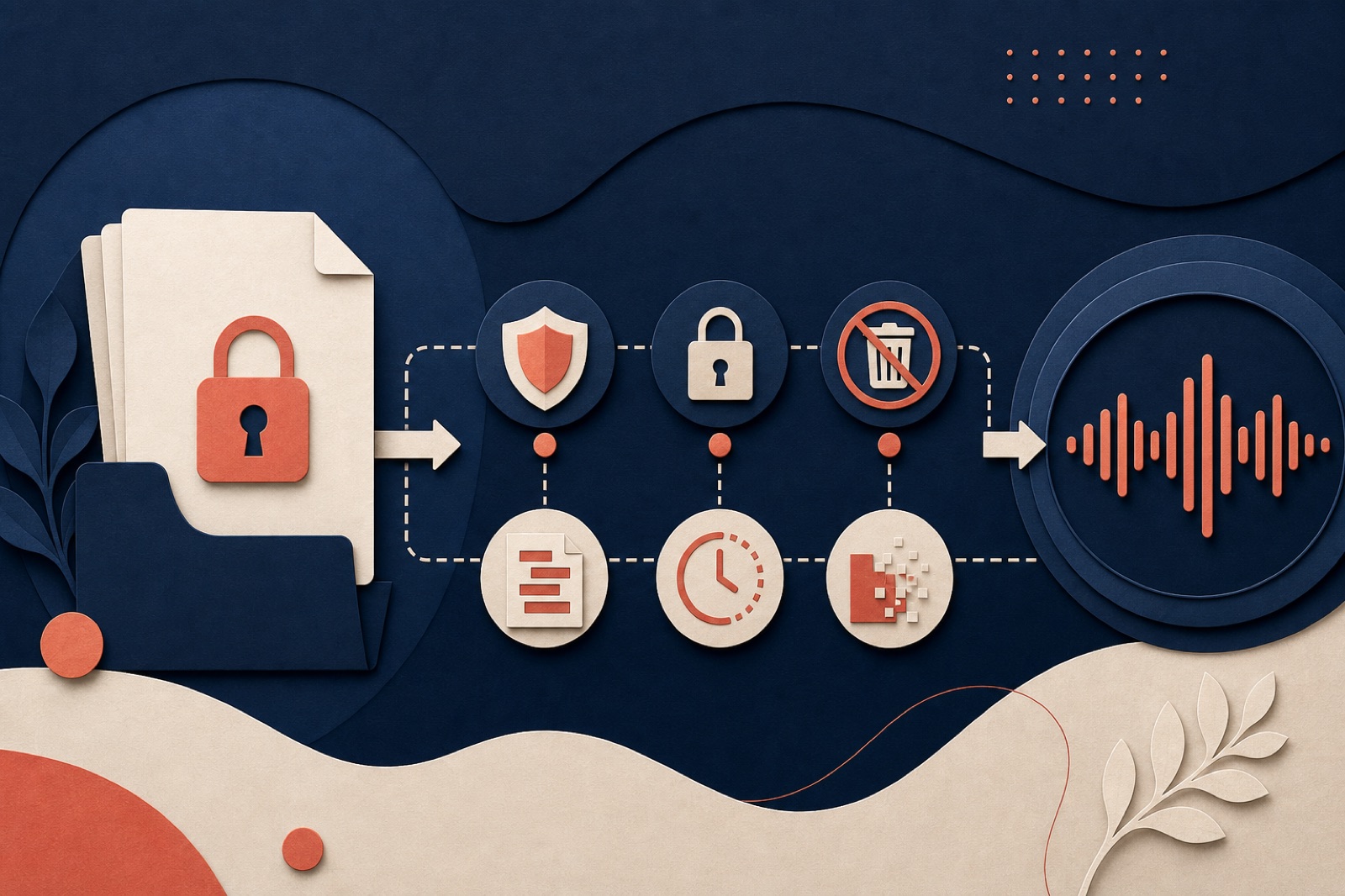
Turning a document into a podcast creates more data, not less. The source may be uploaded, extracted, sent through a language model, converted into a script, rendered by a speech system, stored as audio, cached, logged, and shared. Each copy has its own access and deletion path.
Before uploading a private document, map that path. A polished privacy policy does not answer every operational question, and an encrypted connection does not determine what happens after the file arrives.
This checklist is general risk guidance, not legal advice. Organizations should apply their own contracts, policies, regulatory obligations, and professional review.
Classify the source
Identify the most sensitive information in the document. Examples include:
- personal identifiers and contact details;
- health, education, employment, or financial records;
- customer data and support transcripts;
- unpublished research or exam material;
- confidential business plans, prices, and contracts;
- credentials, tokens, private links, or security details;
- copyrighted material you are not permitted to transform;
- information covered by a nondisclosure agreement.
Classification should follow content, not filename. “Meeting notes” can contain customer names and acquisition plans. A public report may include an appendix that was not intended for distribution.
If you do not have authority to upload or transform the document, stop. Personal access to a file does not automatically include permission to send it to a third-party processor or create a shareable audio derivative.
Minimize before upload
Use the smallest source that accomplishes the listening goal. Remove irrelevant appendices, participant lists, raw exports, and tracked comments. Replace identifiers with meaningful placeholders when identity is not needed.
Data minimization reduces exposure and improves the episode by removing noise. The voluntary NIST Privacy Framework uses data processing and management controls to help organizations reason about privacy risk; limiting collection and processing is a recurring principle in privacy engineering.
Redaction must remove underlying data. A black box drawn over PDF text may leave the text selectable, searchable, or embedded in revision history. Export a sanitized copy, reopen it, and test search, copy-paste, annotations, layers, and metadata.
Never upload secrets. Rotate a credential if it was exposed; deleting a later audio file does not erase logs or earlier copies.
Draw the processing map
Ask the service to identify each processor and storage location:
source file
  → text extraction or OCR
  → script generation
  → speech generation
  → audio storage and delivery
  → logs, backups, analytics, support access
The brand on the interface may use several providers. Review subprocessors for language models, speech, object storage, analytics, email, and error reporting. Determine which steps are local, self-hosted, or third party.
For URL input, remember that the service may fetch the page from its own network. Do not submit an intranet or signed private URL unless the product is explicitly designed and authorized for that access.
Ask concrete retention questions
“We value privacy” is not a retention schedule. Find out:
- Is the original file stored after extraction?
- How long are extracted text, prompts, scripts, and audio retained?
- Are request bodies present in application or provider logs?
- Do backups age out on a known schedule?
- Can support staff access content, and is access logged?
- What does account deletion remove?
- How long after deletion can backups or caches remain?
Distinguish user-interface deletion from provider deletion. Removing an episode from a dashboard may only hide the database row. A complete workflow should delete the source, intermediate artifacts, audio objects, public links, and associated metadata according to the documented policy.
If a vendor cannot answer retention for a sensitive use case, treat that as an unbounded risk rather than assuming immediate deletion.
Understand model-training and review terms
Check whether uploaded content, prompts, transcripts, or outputs can be used to train or improve models. Determine whether the default differs by plan, account type, region, or provider. An opt-out control should be verified rather than assumed.
Also ask whether automated abuse monitoring or human review can inspect content. Those controls may be legitimate, but they affect confidentiality and should be known before upload.
Do not rely on a general statement about one model if extraction, speech, or analytics uses other services. The processing map is what matters.
Review storage and sharing
Encryption in transit protects data while moving over the network. Also ask about encryption at rest, tenant separation, access controls, key management, and public delivery links.
Generated audio is easy to forward. Check whether episode URLs are:
- public and indexable;
- unlisted but accessible to anyone with the URL;
- authenticated;
- signed and expiring;
- downloadable;
- revocable.
“Unlisted” is not the same as private. URLs can leak through messages, browser history, referrers, analytics, and screenshots. Use authentication or expiring authorization for material that should remain restricted.
Check the transcript separately. A protected audio file with a public transcript still discloses the content.
Consider audio-specific exposure
Audio changes how information travels. A listener can play it in a room, car, speaker, or wearable where other people hear it. Lock-screen titles and chapter names may reveal sensitive topics. Downloads can remain on devices after server deletion.
Avoid speaking identifiers that are unnecessary. Use neutral episode titles. Provide headphones and environment guidance for workplace material. If the audio is downloadable, define how managed devices delete local copies.
Synthetic voices also raise identity questions. Do not clone or imitate a real person’s voice without appropriate consent and rights. Use clearly licensed voices and avoid suggesting that a named person spoke words they did not say.
Check legal and contractual boundaries
Privacy is only one dimension. Copyright, confidentiality, records management, data residency, employment policy, educational rules, and sector-specific law may apply.
Questions for an organization include:
- Does the vendor agreement permit this data category?
- Is a data-processing agreement required?
- Are approved regions and subprocessors documented?
- Does the transformation create a record that must be retained?
- Are notices or consent required?
- Can the source be transferred across borders?
Do not turn the podcast into a substitute for an authoritative contract, clinical record, safety procedure, or legal text. Summarization can change meaning even when processing is secure.
Verify the output before sharing
Privacy review continues after generation. Read the transcript and listen for information that should have been removed. Generated dialogue may repeat a name from a footnote or infer a sensitive relationship from nearby passages.
Run the source accuracy checklist at the same time. Then inspect metadata, chapter titles, cover art, filenames, and sharing settings.
Use a second person for high-risk material. Familiarity makes it easy to miss a name or identifier because it feels ordinary to the author.
Make deletion testable
Before relying on a service, create a low-sensitivity test episode and exercise the lifecycle:
- upload;
- generate;
- share privately;
- revoke the link;
- delete the episode;
- confirm the page and object are unavailable;
- request account/data deletion if appropriate;
- record the documented backup expiry.
This test does not prove internal deletion, but it reveals broken public links, unclear controls, and mismatches between documentation and interface.
Use a go/no-go checklist
Proceed only when:
- you have permission to process the source;
- unnecessary sensitive data is removed;
- secrets and hidden metadata are absent;
- processors, model-use terms, and regions are acceptable;
- retention and deletion are documented;
- source, transcript, audio, and logs are all considered;
- sharing uses an appropriate access model;
- the final output has been reviewed;
- a correction and deletion owner is known.
If any answer is unclear, use a less sensitive source, a locally controlled workflow, or do not convert the document.
DuoCast uses a self-hosted speech path to reduce dependence on per-character cloud voice services, but document extraction, script generation, storage, and deployment controls still need an end-to-end review. No single architecture label replaces the processing map.
The safe question is not “Is this AI tool private?” It is “Which data exists at each step, who can access it, how long does it remain, and can I verify the controls?” Answer that before the upload, while you still have a choice.