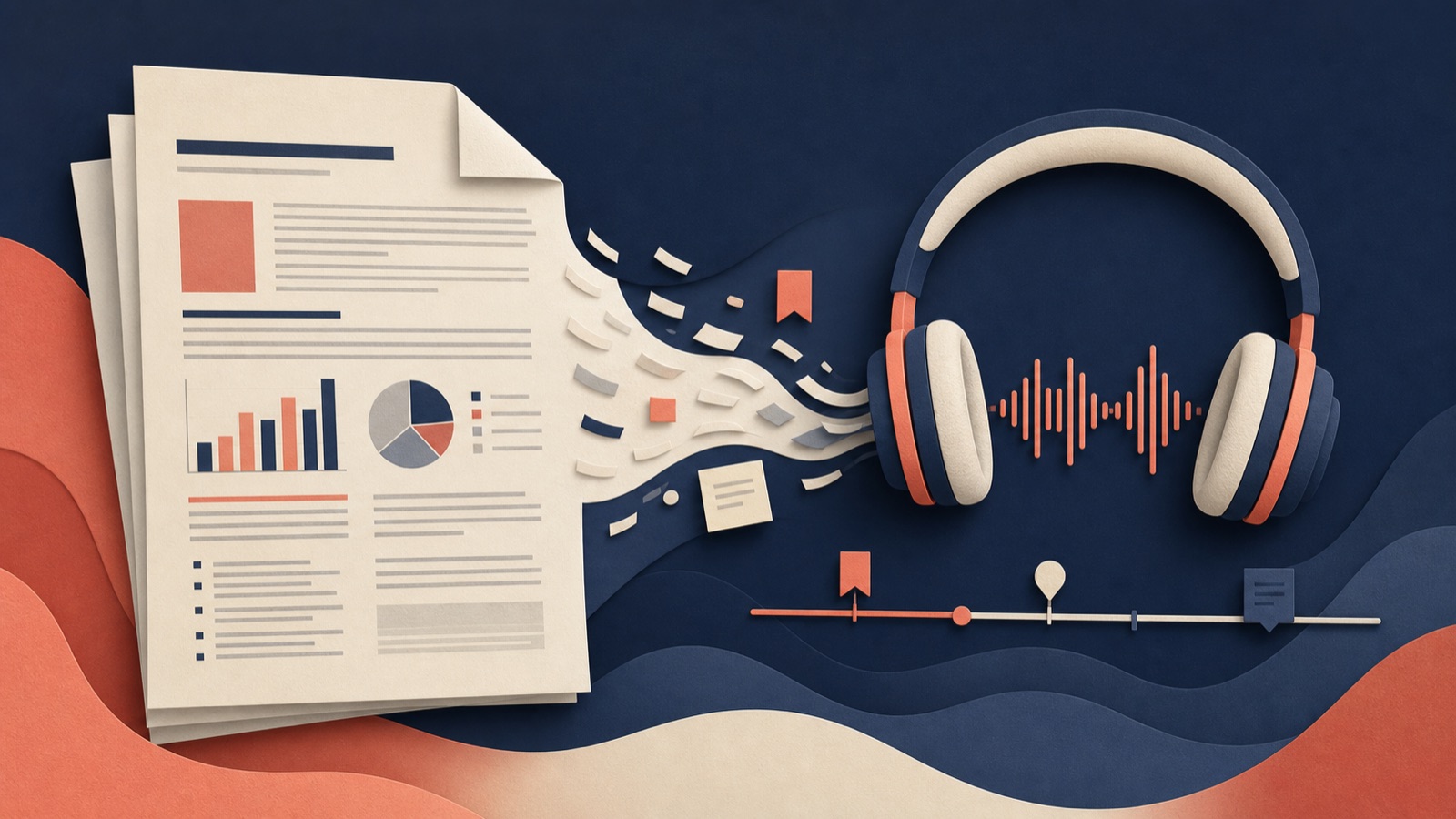
Listening can help you use time when reading is impossible, but a research paper is not an ordinary article. Its meaning may depend on a sampling decision, a confidence interval, a diagram, or one sentence in the limitations section. Turning the PDF into fluent audio without a review plan can make the paper feel clearer while quietly removing the evidence that makes it trustworthy.
A better approach treats audio as one pass in a research workflow. You listen for structure and argument, keep the paper available for visual details, and return to the source before relying on a claim.
Choose the purpose of the listening pass
There are at least three useful listening jobs:
- Triage: decide whether a paper deserves close reading.
- Orientation: understand the research question, approach, and main result before reading technical sections.
- Review: revisit a paper you have already annotated.
Do not expect one episode to perform all three. A triage version should be short, explicit about scope, and careful not to imply that a summary replaces the paper. A review version can assume vocabulary and spend more time connecting methods to results. A first encounter with a proof-heavy or highly visual paper may be poorly suited to audio beyond the abstract and discussion.
Write the purpose at the top of your notes. It changes what you include and how you evaluate success.
Get the authoritative paper
Use the publisher version, accepted manuscript, or repository copy that matches the citation you intend to use. Preprints and final publications can differ. Record the title, authors, year, venue, DOI, and version status.
Check for corrections, retractions, supplements, and linked protocols. A downloaded filename rarely tells the full story. When a paper has supplementary methods or a preregistration, decide whether the main article can be understood without them.
Never remove the abstract, method headings, figure captions, acknowledgements, or references before you understand their role. Funding and conflict statements may affect how you interpret the work. References help distinguish the authors’ new result from background claims.
Test extraction before generating audio
Academic PDFs commonly use two-column layouts, ligatures, footnotes, equations, and floating figures. Copy paragraphs from the introduction, methods, and discussion into a text editor. Confirm the order is correct and that words are not interleaved across columns.
Look for:
- missing minus signs or decimal points;
- Greek letters converted into unrelated characters;
- superscript citation numbers inserted mid-sentence;
- headers and page numbers repeated as prose;
- figure labels separated from captions;
- hyphenation that splits one term into two;
- scanned pages with no text layer.
If the file is scanned, perform OCR and review it first, including reading order, names, numbers, and mixed-language passages. For equations, preserve the original page reference even if the audio uses a plain-language description.
Build an evidence map
Before converting the whole paper, make a compact map:
| Element | Question to capture | | --- | --- | | Research question | What exactly are the authors trying to learn? | | Population or material | Who or what was studied, and in what setting? | | Design | Observational, experimental, qualitative, simulation, review? | | Measurement | How were the important variables defined? | | Main result | What changed or differed, and by how much? | | Uncertainty | What interval, sensitivity test, or competing explanation matters? | | Limitations | What does the paper explicitly say it cannot establish? |
This map prevents the episode from becoming an extended introduction followed by a dramatic conclusion. It also exposes missing information. If you cannot state how a key outcome was measured, the source needs closer reading before it is ready for audio.
Make methods audible
Listeners do not need every procedural detail during an orientation pass, but they do need enough to understand what the result means. “Researchers found” is usually inadequate. Say whether participants were randomly assigned, surveyed once, followed over time, or selected from an existing dataset.
Separate association from causation. A host can ask, “Does this design show that X caused Y, or only that they moved together?” The answer should come from the method, not from a generic disclaimer added at the end.
For reviews and meta-analyses, explain inclusion criteria and the types of studies combined. For machine-learning papers, identify the evaluation dataset, baseline, metric, and whether the test data resembles the intended use. For qualitative work, describe recruitment, coding, and the context in which themes were developed.
The goal is not to turn methods into a lecture. It is to give each claim the minimum frame required to interpret it honestly.
Translate figures without pretending they are prose
Figures should be described, not flattened into a list of numbers. State what is compared, the direction and approximate size of the main pattern, and the exception a careful reader should notice. Then keep a chapter marker or page reference so the listener can inspect the visual later.
For example:
Figure 2 compares error rates for the proposed model and three baselines over five datasets. The new model leads on four datasets, but the advantage is small on two and reverses on the smallest dataset.
That description is more useful than reading twenty cells. It is also less misleading than saying simply that the model “outperformed the baselines.”
Do not verbalize a confidence interval as decorative detail. Explain what it contributes: precision is low, plausible effects include little change, or two estimates overlap substantially. Avoid converting statistical significance into practical importance.
Use dialogue to expose questions
A two-host structure is valuable when the hosts have distinct jobs. One can reconstruct the authors’ argument; the other can ask what evidence supports it. Useful questions include:
- What would we expect to observe if the authors’ explanation were wrong?
- Which participants or cases were excluded?
- Is the reported effect large enough to matter outside the study?
- Does the conclusion apply beyond this setting?
- What result surprised the authors?
- Which limitation changes how we should use the finding?
The second host should not manufacture controversy. Questions must be answerable from the source, and uncertainty should remain uncertainty. Create contrast between the headline and measurement, or between what the paper shows and what it leaves open, without inventing expertise or opinions.
Listen in two passes
During the first pass, do not pause for every detail. Capture the question, design, main result, and one uncertainty in four lines. If those are unclear, the episode needs revision or the paper needs direct reading.
During the second pass, use chapter markers. Pause at methods, figures, and limitations. Compare the transcript against the corresponding pages. Write questions rather than polished notes:
- Why was this outcome chosen?
- Is the subgroup analysis planned or exploratory?
- What does the missing-data rule exclude?
Questions keep you connected to the evidence. A smooth summary can otherwise create the false feeling that the paper has been mastered.
Know when audio is the wrong mode
Use the PDF directly when notation, code, maps, microscopic images, dense tables, or exact legal wording are central. Audio can still provide orientation, but it should not replace inspection.
Listening is also a poor fit when you must quote precisely, reproduce a method, or make a high-stakes clinical, legal, safety, or financial decision. Return to the paper, relevant professional guidance, and the broader evidence base.
Research on listening and reading does not support a universal claim that one mode is superior. A review on listening comprehension shows that listening and reading draw on related language comprehension, while specific outcomes depend on the learner and task. Choose the mode for the job, not for a slogan.
Keep a reproducible record
Store the paper citation, exact source file, generation date, transcript, and your corrections together. Mark quotations and paraphrases. If you share the episode, link the paper and identify whether it was a preprint.
Before using any claim, run a source-accuracy check:
- Find the statement in the transcript.
- Locate its supporting passage, table, or figure.
- Verify population, comparison, magnitude, and uncertainty.
- Read the surrounding paragraph for qualifications.
- Check whether a correction or later version changes it.
DuoCast can turn a paper into a conversational listening draft, but the useful workflow is larger than conversion. Audio helps you orient, review, and form better questions. The paper remains the evidence.
When listening leaves you knowing where to look and what to challenge, it has done its job. When it makes the source feel unnecessary, it has probably hidden too much.